From Queens to Mexico City, and pretty much nothing in between.

Wednesday, April 25, 2012

Licuados - Banana Breakfast Shakes

licuados
When I go into whatever Mexican City office I'm teaching class in every morning, I always see the same break room staples - a water cooler, a coffee pot, and a blender. A blender? Yes, of course, because one of the most beloved breakfasts (and most beloved drinks) here is the licuado - a cold, thick, fruity shake. A licaudo, called such because it is made in a licuadora (blender), is translated as milkshake, but this is misleading because there is no ice cream. On the other hand, it's also quite apt because it is literally shaken milk.

Forget about diet shakes for breakfast. Here, people blend ice, whole milk and fruit to make a homemade breakfast shake for kids and parents on-the-go. The most popular fruit is bananas, but any fruit can be blended in, and some people even include oats and eggs to give themselves a more complete breakfast.

I have discussed my dislike for fruit before, but the ways that some fruits are being prepared here are really making me change my mind.

Ingredients
500 g whole milk (2 1/2 cups)
3 bananas
2 Tbsp. sugar
4-5 ice cubes
1/2 teaspoon vanilla (optional)

Directions

1 - Put milk, bananas, ice, sugar, and vanilla (if using) into a blender.

2 - Pulse on low speed 5-6 times. Then, blend on the highest speed for at least 30 seconds to let it get really frothy.

3 - Drink your licuado immediately (or else the frothiness from blending will become flat).


Wednesday, April 11, 2012

Flor de Calabaza (Squash Flower)

squash flower flor de calabaza
Or pumpkin flower? Or zucchini flower? The Spanish language does not really specify, and while I had always believed they were pumpkin flowers (because of the orange), my source (Rick Bayless's Authentic Mexican glossary) does indeed say that they are called squash flowers in English.

The flavor is similar to the vegetable from which it comes, and these flowers are found in a variety of Mexican dishes, though I have usually seen them in soups or, most commonly, quesadillas. I have never actually seen them in the United States, but flor de calabaza quesadillas are often the daily special at lots of Mexican restaurants in Queens (so you must be able to get them somewhere).

To use fresh flor de calabaza, there's a bit of prep work involved. You must first clean them of course. Then, remove the woody stems and the center from the flowers (my biology lessons and internet are failing me - stamens? pistils?). If you want to make them into the oh-so-beloved quesadillas, the flores get sliced and fried with onions, chile, tomato and garlic to become the filling.

Mexican culture and cuisine is overwhelmingly carnivorous, so when my uncle-in-law told me that the best thing he had ever eaten was a flor de calabaza quesadilla that he bought on the side of the road in some pueblo in Veracruz, well, that says a lot about the flavor of this little flower.

Wednesday, April 4, 2012

Milanesa Tortas

milanesa tortas
As a child, I always hated "Sandwich Night"; a few slices of cold cuts and some American cheese on a kaiser roll never really piqued my culinary interest. And while I have yielded on the cold cuts a bit in my culinary maturity (which would have happened a long time ago if my parents had involved roast beef and swiss cheese in the equation), the Mexican option of the "milanesa" sandwich has really changed my attitude towards sandwiches in general.

"Milanesa" is the term used to refer to a very thin piece of meat (any kind, beef, pork, chicken, etc..) that is breaded and fried (schnitzel, according to the dictionary). Milanesa beef or pork is most popular in the torta carts, and these are "torta cart" style of tortas (vs. "taqueria" style torta", which I will save for another day). That means more vegetable toppings, whole pieces of meat, and refried beans.

Ingredients
4 pork cutlets, pounded super thin and flat
milanesa tortas1 cup flour
1 egg
1 cup breadcrumbs (or Panko, if you like to be trendy)
salt and pepper
oil for frying
4 bolillos (or kaiser rolls, I guess)
butter
mayonnaise
1 cup refried beans
1/2 pound of quesillo (or any mild white melting cheese), sliced or shredded
1 tomato, sliced
1 avocado, sliced
1 red onion, sliced
1 can of chiles chipotles or jalapenos in vinegar

Directions

1 - Fry up your milanesas. Fill three shallow dishes with the flour, egg, and breadcrumbs, respectively, all seasoned to taste. Heat a half an inch of oil in a large skillet over medium heat. Dip the pork in the flour, then the egg, then the breadcrumbs. Cover completely. Fry the milanesas for about 4 to 5 minutes on each side. Set aside.

2 - Fold/cut milanesas into sandwich size/shape pieces. Return each milanesa stack to a dry skillet over low heat. Place the cheese on top and cover the pan with foil to melt the cheese. Turn the heat off after a minute or so, and let the cheese keep melting.

3 - The rest is pretty much al gusto, but a complete sandwich (in my home) would have the bolillo toasted with a bit of butter; a smear of refried beans on one half and a smear of mayo on the other; a row of sliced onions, the meat and cheese; topped with tomatoes, avocados, and the chiles of your choice (but not both).

4 - The best way to do "Torta Night" is to set it up buffet style and let everyone put as much or as little of each of the toppings as they like, and then truly enjoy their torta milanesa.

milanesa tortas

PS - These have nothing to do with Milan; I have no idea why they are called that.


Thursday, March 29, 2012

Mexican Rice

mexican rice
Rice and pasta, known as sopas, are standard side dishes here in Mexico, and they are usually kept pretty simple - margarine, onion, or pureed tomatoes, usually. In all the meals that I have eaten and then all that I have made, there is a clear pattern in which rice goes with which meal. Simple white onion rice goes with chile seco, ribs or salsa verde; arroz amarillo (rice cooked in tomato puree) is absolutely necessary for chiles rellenos and pretty common for mole.


This rice recipe is a much more substantial rice, a traditional Mexican vegetable rice. It's also the kind of rice that you find on the side of your enchiladas at On The Border and other Mexican chain restaurants.


While this recipe is traditional, in my experience, it's not an everyday recipe. Too many ingredients, too expensive, too time-consuming, but this rice is a great thing to make when you have a lot of leftover vegetables. It's satisfying as a side dish, but after all that chopping work that you've done, go the extra step, throw in some shrimp or shredded chicken and make it a meal. (Or throw in both and some chorizo, and have yourself a nice little fake-out paella-esque dish).


Ingredients
3 Tbsp. vegetable oil
1 jalapeño, finely chopped
1 red onion, finely chopped
4 roma tomatoes, finely chopped
2 cups rice
1 cup frozen peas
1 tsp. oregano
1 tsp. cumin
1 tsp. black pepper
1 tsp. salt (more or less, but be careful; some stock can be really salty)
3 1/2 cups chicken stock (or water and a stock cube)


Directions


1 - Heat the oil in a deep pot with a lid.


2 - Add the onion, and cook for about 10 minutes or until translucent. Add the jalapeño and the tomato and cook another 5 minutes, until softened.


3 - Add the rice, and toast for about 5 minutes.


4 - Add the oregano, cumin, black pepper and salt. Stir well.


5 - Add the chicken stock, stir well, and bring to a boil over low heat.


6 - Put the lid on, turn to low heat, and cook the rice for 25 minutes.


7 - Add the peas, and put the lid back on for about 5 more minutes (or until peas are defrosted and heated through).


8 - Fluff with a fork and serve.

Monday, March 26, 2012

Mexican Cheesecake

cheesecakeOK, so there is very little Mexican about this recipe. In fact, Mexico has its own style of cheesecake all its own, pay de queso (cheese pie), which you will see in this blog one day, but for now, I just need to brag on my Mexican husband a bit.

Now, there are three Mexican-specific elements to making a New York style cheesecake here in Mexico City. First, lemons are fairly pricey and annoyingly difficult to find, so we use limes.
cheesecakeSecond, I have never seen a graham cracker in any of the supermarkets or warehouse stores that I have been to, so we use Maria cookies or this great nuez-flavored cookie (nuez literally means nut, but refers to pecan here), called Marianitas - which really adds this great level of flavor.

Third, squeezee bottle dulce de leche is pretty much a standard staple here, so we went ahead and swirled some of that in, too.

So, it's not Mexican, but my husband is...and it looks so pretty!

Wednesday, March 21, 2012

Proper Piñata Protocol

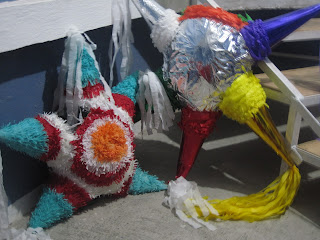
piñatasSo, it's that birthday time of year again (well, for me and Benito Juarez and springtime, at least), and after writing about mañanitas and diving head first into tres leches, it's about time for some piñata facts.

1 - I have never seen the rainbow donkey (in piñata form...or in real life, for that matter) that seem to be the traditional American piñata. It may be popular up north, but here in South Central, it is all about the traditional form of the five pointed star. Dora, Santa, and other human shapes are also common enough (but there's something weird about beating those ones).
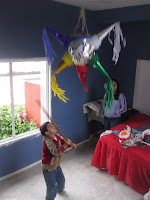
piñatas2 - Piñatas are for birthdays, but also for other holidays, like the Posadas (9 days before Christmas), Christmas and New Year's Eve, but much to my dismay, hitting the piñata and knocking children over for candy seems to be only for other children.

piñatas3 - The best and most popular piñata candy is the Damy, a hard candy of milk and peanut flavoring, or its brother, Tomy, a caramel hard candy. (You can get them online and in highly Mexican areas, and I would recommend finding and trying them.)

4 - The number one rule of the piñata is that the youngest/smallest kids go first, the biggest/oldest ones last; that way, everyone gets at least one at bat.

piñatas5 - In the United States, we have the blindfolding, the spinning, and the moving of the piñata all right, but we lack the song. And the  piñata song is really quite important because it keeps the time of each child's turn.

Dale Dale Dale, Hit it, Hit it, Hit it,
No pierdas el tino, Don't lose your aim,
Porque si lo pierdes, Because if you lose it,
piñatasPierdes el camino. Then you lose your way.

Dale Dale Dale, Hit it, Hit it, Hit it,
Dale, No le dio, Hit it, No you didn't,
Quitenle la venda, Take off the blindfold,
Porque sigo yo. Because it's my turn.

Ya le diste una, Now you hit it once
piñatasYa le diste dos, Now you hit it twice
Ya le diste tres, Now you hit it three times
Y tu tiempo se acabo! And your time is done!


OK, so the song really does not translate well into English, but the idea is that when the song ends, so does your turn.

(Note: I know most of these pictures are inside, but that's because it rained all Christmas week in Veracruz this year. Generally, you want to do this whole piñata thing outdoors.)

Wednesday, February 29, 2012

Café de Olla

cafe de olla
Despite the sweltering heat, coffee is very popular in Veracruz, and while there are a few cafés, you certainly won't find coffee makers in most homes. In any market, tianguis or baratero, you can get fresh ground local coffee, which is then boiled in an earthenware pot (an olla) with piloncillo and cinnamon to become Mexico's unique brand of coffee, café de olla.

In my experience, the beverage is just skimmed from the top of the pot (or made from Nescafé - also very popular in Mexico), but just to be sure that you don't get a mouthful of some very bitter coffee grounds, strain, STRAIN, STRAIN!

Ingredients
1 liter water
1 cinnamon stick
100g piloncillo (or brown sugar, but it's not the same)
50 g ground coffee (or Nescafé it)

Directions

1 - Put the water, coffee, cinnamon stick and piloncillo into a pot.

2 - Bring to a simmer, and stir to dissolve the piloncillo.

3 - Allow the coffee to steep for about 5 to 10 minutes.

4 - Take out the cinnamon stick, and strain the coffee through a fine mesh strainer (twice).

5 - I probably don't need to mention it, but serve hot.